
By Kerwin Holmes, Jr.
For as Jonah was in the belly of the huge fish three days and three nights, so the Son of Man will be in the heart of the earth three days and three nights.
-Matthew 12:40
When a prophet speaks in the Lord’s name, and the message does not come true or is not fulfilled, that is a message the Lord has not spoken. The prophet has spoken it presumptuously. Do not be afraid of him.
-Deuteronomy 18:22
A PRIMER
Where there are difficulties in the texts of Scripture, Christians ought to be the first ones eager to see them exposed, and also those most capable of expressing delight in their resolution. By that I mean this: complexities of the Scriptures that arise from us reading at a surface level and coming away thinking “Well, wait, that does not make sense nor fit with Scripture over here…” ought not to cause us to suddenly forget what we have seen. We are not the Men in Black. Scripture is not an alien crime scene. And no one is able to wash these things from memory. Scripture stands resolute, profound, and publicly available for all. Yes, it is available even for that militant atheist down the road, or that nagging family member who just loves to cut at you whenever you say grace before a meal. As said in two previous posts, and as demonstrated in some of my more recent posts, we should never hide from critics.
With all of that said, there is one great discrepancy that stands to threaten the core basis of the Christian faith. Among the great celebrations and commemorated events of Church history, the most important and primal festival of Christendom has recently passed, and by that singular I actually mean two: 1) The Passover and 2) the Resurrection Celebration of our Lord Jesus the Messiah (which is same word “Passover” in most languages, but Easter in Modern English).
This season hit home this year (2021) for myself for particular reasons, if I may take a moment to express some personal sentiments. This time last year, the Church in the West and around the world largely chose to conform to the world enslaved to this age and to not meet together to celebrate our Lord’s decisive and conclusive victory over death because of the fear of death. Heartbreak does not adequately express the event that I felt in this news, even as, submitting to the Scriptures, I advocated that each Christian use his or her best ability to submit to and to follow the leadership of the elders within their own congregation. Now, the Church is only a monarchy at the level of the Triune God and of Christ as the eternal Davidic son upon the throne of the Universe and the throne of David, completely human as He is also completely God. To glorify God in this season this year is a great delight, and one of the greatest sources of encouragement for me.
That said, I would be remiss to not acknowledge some realities. The Church is not out of the woods at all, by far, even, from Panic 2020. We are still enthralled in the idolatrous seizures of power of State officials wherever we reside, the bespectacled Big Brother machinations of the Globalist elites, and the hamstrung and castrated leadership of malakoi still within our midst. But we are still here. The Church of Christ still lives upon His world.
And Christ’s victory is our victory. And though this period may truly become dark, darker than we imagine presently, by the same hand that has caused such darkness to ingress upon our moment of lax complacency, the hand of God, the Church will continue on the other side of the storm wiser and more beautiful than she was before.
THE DISCREPANCIES
But, as Paul noted, that victory is not assured if the Messiah is not raised. And if Messiah is not raised, then we are left without hope. But even more, if Jesus cannot be trusted at His words, then we do not have hope. It was Jesus who prophesied of His death and His resurrection. It was Jesus who provided us with the sign:
For as Jonah was in the belly of the huge fish three days and three nights, so the Son of Man will be in the heart of the earth three days and three nights.
Matthew 12:40, Christian Standard Bible (CSB)
Though Church tradition certainly is strong and valuable, there is a problem here that many point out. The traditional weekly timing of Jesus’s death is on Friday, Good Friday, and His resurrection is taken to have occurred on Sunday (even sometimes corresponding to sunrise on Sunday morning). The problem, however, is that this timing does not allow for Jesus’s prophecy of His own burial to be fulfilled. From Friday night (as Jesus died before sundown, see Matthew, Mark, Luke, and John) to Sunday morning there are only 2 nights and 1 day. No matter how one slices it, these are not 3 days and 3 nights. No, it is not enough that “parts” of a day count as the whole. Jesus’s voice is clear, and it mirrors the same language of the Creation Week (more on that later). Just as we do not read the story of Jonah and take Jonah to have only been in the huge fish for parts of 3 days, so we ought to take Jesus’s words and reading of Scripture as is.
It only takes a single false prophecy for a prophet to be discredited forever, according to God in the Scripture. That verse is given up above in the beginning of this post. If Jesus was a false prophet, then He cannot be the Messiah. And so, the entirety of the Christian faith would crumble into dust.
But there is yet another issue. As discussed in a previous post, the gospel narratives have a Synoptic tradition between Matthew, Mark, and Luke in which these 3 narratives share the flow of events very similarly to one another. In this way, they are said to “see together” the events of Jesus’s life, hence the Greek-derived named “Synoptic” is given to them. The Gospel of John has a different vantage of events, which some say are even contradictory to the Synoptic tradition. Nevertheless, among the Synoptic Gospels we have another problem: When did the women buy and prepare the spices for Jesus’s burial?
53 Taking it down, he wrapped it in fine linen and placed it in a tomb cut into the rock, where no one had ever been placed. 54 It was the preparation day, and the Sabbath was about to begin. 55 The women who had come with him from Galilee followed along and observed the tomb and how his body was placed. 56 Then they returned and prepared spices and perfumes. And they rested on the Sabbath according to the commandment.
Luke 23:53-56
16 When the Sabbath was over, Mary Magdalene, Mary the mother of James, and Salome bought spices, so that they could go and anoint him. 2 Very early in the morning, on the first day of the week, they went to the tomb at sunrise.
Mark 16:1-2
With the Crucifixion Day being traditionally understood to be on Friday, both of these cannot be true. For one, Mark clearly states that the women bought the spices after the Sabbath was over, precluding their ability to prepare the spices before the Sabbath began. But Luke clearly states that the women prepared the spices before Sabbath began, having time to do so. For those who do not know, the Sabbath was the only day of the Jewish week that received its own name, and Sabbath corresponds roughly to Saturday for the standard Western weekly calendar.
Now, traditionally, the solution to this apparent discrepancy was simply to state that the women waited until very early on Sunday to do their work. But that does not work with Luke, since the women were able to not only acquire the spices before Sabbath, but also to prepare them. Even more, with it being so close to the evening when they began their work, the super-fast women (at least according to Luke) able to both buy and prepare the spices even after seeing where Jesus was laid to rest would have definitely not needed to rush on Sunday.
But it is best to stick with the plain reading of the fact that the women could not have both purchased the spices and prepared them after the Sabbath had ended and also have already prepared the spices before the Sabbath began. Assuming that this event really did occur and that the tradition was shared among eye-witnesses, there is clear reason to see this discrepancy with adequate suspicion. If there were a discrepancy in witnesses, such an obvious contradiction would be easy to quickly resolve before writing the event down. And yet, the event having survived this oversight for so long, there it remains.
But wait, there is more. The Synoptics are clear that Jesus died on the Passover. Let me explain. Jewish weekdays are not like days as commonly reckoned in the Western weekly calendar. Though both weekly calendars share the daytime of each day in common (for instance, the full daytime of Friday in the typical Western calendar matches with the full daytime of Friday for Jewish reckoning). However, while they share this, the Western calendar divides the night in half (roughly) according to each day, making a schema for where a single day shares half of a night (roughly speaking) on either side of the day. This is why there is something called a midnight in the typical Western weekly calendars. Here is a diagram to show that.

The grey portions represent “nighttime.” Sunrise, or the time designating the daytime is clearly marked. As you can see, in line with common parlance, midnight marks the shifting of one day to another. Without a timepiece (a watch) or some basic knowledge of astronomical occurrences (and basic night visibility to match such knowledge), the measuring of days in the modern Western schema can prove to be quite difficult.
In the Jewish reckoning that is not the case. The Jewish reckoning comes directly from Genesis 1, where we read of God creating time itself, establishing the heavens and the earth in substance and then ordering their substances into the systems of interlocking and populated networks that we have come to know and love. Genesis 1 is very clear on the ordering of the day, but for the untrained eye (especially for those who are not Creationists, I might add) detecting this is difficult. A quick glance at the opening verses of Genesis 1 reveals how the Jewish reckoning of weekdays works:
1 In the beginning God created the heavens and the earth.
2 Now the earth was formless and empty, darkness covered the surface of the watery depths, and the Spirit of God was hovering over the surface of the waters. 3 Then God said, “Let there be light,” and there was light. 4 God saw that the light was good, and God separated the light from the darkness. 5 God called the light “day,” and the darkness he called “night.” There was an evening, and there was a morning: one day.
Genesis 1:1-5, emphasis mine
As you can see, for religious Jews (but also how days were reckoned throughout the entire Bible unless noted otherwise) the telling of each day was simple in that each day began with nightfall and ended at the next instance of nightfall. Here is a diagram to understand that (and keep in mind that, still, the daytime period of the Jewish calendar does line up with the Western daytime for each day):

Telling days apart in the Jewish setting is far easier than in the Western reckoning, as all one would need to know is the position of the sun relative to the horizon. And all 4 gospel narratives used the Jewish reckoning of days.
(It is also for this reason that Jesus’s prediction of 3 days and 3 nights is non-negotiable. If Jesus was wrong, and did not know what even the most basic Jew of his time knew about what a day or a night was, then not only was He not the Messiah, but He also was not the Creator of the universe. The stakes are very high.)
But that said, you may notice that during the night before the crucifixion, Jesus was celebrating the Passover with the disciples according to the Synoptic gospels. Mark, Luke, and Matthew are adamant that Jesus celebrated the Passover with His disciples. And now that you have an eye trained to read the nighttime as the start of the Jewish day, you can understand why every Synoptic account mentioned the day approaching and then jumped into the evening or nighttime. But that day was the first day of the Feast of Unleavened Bread when the Passover was celebrated according to each account. That cannot be denied. However, when one reads the Gospel of John, the one account outside of the Synoptic tradition, one gets another and apparently contradicting testimony. Not only is the last meal that Jesus ate with His disciples before His death not called the Passover or even identified as the Unleavened Bread at all, but Jesus is even said to have died specifically before the Passover ever began (the day before, to be exact).
13 When Pilate heard these words, he brought Jesus outside. He sat down on the judge’s seat in a place called the Stone Pavement (but in Aramaic, Gabbatha). 14 It was the preparation day for the Passover, and it was about noon. Then he told the Jews, “Here is your king!”
John 19:13-14
The Greek word for “preparation day” is the word παρασκευὴ, which more or less corresponds to the Modern Greek word for “Friday.” However, just like we found out in another word study, we should not assume that the modern and Christianized Greek language is representative today for what the Ancient Greeks spoke in Jesus’s time. At the outset, most Ancient Greeks did not share in the same reckoning of time as the Jewish people, and for another just basic fact, Ancient Greeks did not observe the Jewish weekly Sabbath, if they even knew how to do so or heard of it. The Ancient Greeks had a completely different religious system and in the Roman Empire the days of the week were identified by the major gods and their planets for the 7-day week (see here for another resource for that). Suffice it to say, for the texts of the New Testament, all that we may interpret is that the παρασκευὴ was the day when preparations were done, the word simply meaning “preparation” in Ancient Greek. The weekly context along with the ways in which the gospel writers used the word will have to inform us on what precisely is meant by these texts.
Nevertheless, it is undeniable that the “preparation day” was the day before the day that was being prepared for. Now, all 4 gospel accounts agree that Jesus died on a “preparation day,” but the Gospel of John is explicit that this was the preparation day of the Passover. This means that Jesus, according to the Gospel of John, died the day before the Passover, and not on it. Even more, it was about midday when Jesus was tried by Pilate, and as we have seen in the above two diagrams, that places Jesus squarely before the Passover day in Jewish reckoning and even in the reckoning of modern Westerners.
So, to recap, we have some major discrepancies with the traditional understanding of the Crucifixion Day being on a Friday. These are:
- There are not 3 days and 3 nights from Friday night to Sunday morning, but rather only 2 nights and 1 day. This would make Jesus to be a liar, and therefore a false prophet, disqualifying Him from being Messiah and discrediting both His death and resurrection as anything meaningful (even if still trusting that the latter event happened).
- The women cannot have prepared the spices before the Sabbath began and then also have bought and prepared the spices after the Sabbath ended.
- Jesus could not have died on the Passover and also have died the day before the Passover.
- All 4 gospel accounts say that Jesus died on the “preparation day.”
As you can see, these discrepancies are not small. In fact, many a disbelieving or liberal Bible scholar is completely knowledgeable of these issues, and when Christians go off to university, engage adherents of other religions, peruse the intellectual web, they will encounter these challenges. Now, there is a history of the Church that may look into how this has been so tragically missed, but I am not going there today. Look, here I am exposing my readers to those very same challenges. I do so because I care, but I also do so because when we do not hide from critics, but learn to adequately and responsibly challenge our preconceptions and find them to be possible misconceptions, even in the light of strong Church tradition, very cool things tend to happen.
And when I say “very cool,” I really mean very cool.
THE EXEGESIS
This is where the fun begins. Already, you may have learned a good bit, especially regarding how the Bible reckoned the division of weekdays. The main trouble of all 4 points of above discrepancy on what weekday Jesus was crucified centers around the Passover and the Feast of Unleavened Bread. That’s right. Both the Passover and the Feast of Unleavened Bread are different feasts according to the Bible, more specifically the portion that tells the Law of God (the Torah).
But those who are knowledgeable concerning the customs of Modern Jewry know that Passover and the Feast of Unleavened Bread are celebrated as one the same celebration. Yes, that is true. However, I am here to tell you that the modern practice of celebrating the Passover and the Feast of Unleavened Bread together is not completely sound with the Bible. In fact, I am here to tell you that modern Jews, for the most part, only celebrate the Feast of Unleavened Bread and do not celebrate the Passover.
Let me explain by going to the Scriptures.
The first instance of a holiday at all, the very first holiday given in the Bible which also becomes the paradigm for the entire Biblical narrative, is the Passover given in Exodus 12. Now, although the Passover is given, it is an actual historical event in Exodus 12 which is the culmination of the God of gods, Yahweh, entering into judgment with the Egyptian gods and the Egyptian people. Now, there has been much debate on what day the actual Passover day is. When one reads Exodus 12, one gets to verse 6 and realizes that the Passover lamb was to be kept until the fourteenth day in the month of Nisan/Abib, which was to thenceforth be the very first month of the Hebrew calendar. The rub lies in the language of verse 6 in regard to when the animal was to be slaughtered. Traditionally, Biblical exegetes have held commonality with Rabbinic tradition that this was done in twilight, just as the sun was setting (remember the reckoning of Jewish days). This is often taken to not mean that the animal was actually killed for Nisan-14 (which is how one writes the 14th day in the month of Nisan/Abib), but actually for Nisan-15 as the previous day was ending. By the way, the names Nisan and Abib refer to the same month, it is just that one name was adopted from the Babylonian-Persian naming of months.
But there is a problem there, for the Hebrew does not really say “twilight,” but actually has an obscure idiom for the time to sacrifice the Passover lamb. The words there are actually “between the two evenings” or in Hebrew beyn ha’arbaim, or in written form בֵּ֥ין הָעַרְבָּֽיִם. This is usually taken to mean “just as the sun is setting.” But I disagree with that reading, in part because of another place where the same imagery of eventide is used. In Leviticus 23, the major pilgrimage holy days of the Hebrew calendar are reiterated (they are reiterated in Exodus 23 and Deuteronomy 16). In Leviticus 23:26-32, the Day of Atonements, Yom Kippurim known now by Rabbinic tradition as Yom Kippur, is given (yes, in the Torah, the atonements are pluralized). Notably, the Torah is explicit that the day is to be celebrated on the 10th day of the month of the seventh Hebrew month, the month of Tishrei/Ethanim. However, the functional reckoning of that day is given in verse 32. The result is this:
26 The Lord again spoke to Moses: 27 “The tenth day of this seventh month is the Day of Atonement. You are to hold a sacred assembly and practice self-denial; you are to present a food offering to the Lord…32 It will be a Sabbath of complete rest for you, and you must practice self-denial. You are to observe your Sabbath from the evening of the ninth day of the month until the following evening.”
Leviticus 23:26-27; 32
You will notice that the 10th day is reckoned as going from the evening of the 9th day to the following evening. Now, judging by the chart above and how this language is provided, it can only be understood that the “evening of the 9th day” here did not refer to the actual beginning of the 9th day, according to previous context, but instead the waning or ending of the 9th day. This is not always the case in the Hebrew Bible, but in this case of context, it is so. Nevertheless, what can be gleaned from this passage is how the Ancient Hebrews understood days to go. Whereas in Western traditions, days go from midnight to midnight, meaning that they begin at 12:00 am and end after the expiration of 11:59 pm, the Ancient Hebrews judged complete days as going from evening to evening. Even consulting the chart above, that becomes clear. Interestingly enough, as you can see from verse 32, the Day of Atonements was to be reckoned as a Sabbath day. In fact, all of the major holidays reiterated in Exodus 23, Leviticus 23, and Deuteronomy 16 have designated Sabbath days in them (more on this relatively soon).
Theologian’s Note: This is to say that there is no necessity for reading the evening of any particular day to be its beginning or its end, seeing as the evening is the dividing point for days and can go either way within context, much like “midnight” in our current solar reckoning. I realize now that the phrase “between the evenings” actually has weight in being translated as “twilight” or the period from the setting of the sun to the sky being completely dark. It is always good to question traditions, and since my questioning here led to a pretty sizable discovery, I kept on questioning further into the obscure turn of phrase in Hebrew here. But I now recant that view. What I do not recant is my view that the Messiah died on a Wednesday weekday. Even as this year 2023 demonstrates. As it was, my argument for the turn of phrase does not affect the “Resolution” of this post’s argument at all. And I could simply delete it from this post and the Biblical supports would be the same. But for the sake of transparency, as we also need to remember that we are continually growing in the truth, I will leave my argument as it stood three years ago. Only realize that I no longer hold to this view for the phrase “between the evenings” but now align to the “twilight” view. Semper reformanda. [edited April 4, 2023]
But here is the rub. For the ruling of the Day of Atonements, the reckoning happens on the 9th day’s evening. In the ruling given in Exodus 12 for the Passover day, the reckoning is given until the day of Nisan-14. Since the Ancient Hebrews reckoned days to go from evening to evening, the passage is better understood as saying this:
“You are to keep that unblemished lamb without any broken bones until the day of Nisan-14. Then, during the course of that day, which is to say, as long as that day is present from evening to evening, you are to sacrifice it to Me.”
Now, I know that some will rebuff what I have just said. But I have an ace in the hole here. Well, several aces, to be precise. I now present my first ace:
Leviticus 23.
Yes, that very self-same chapter that we just read from concerning Yom Kippurim. On what day is the Passover day according to Leviticus 23? Let us see:
4 “These are the Lord’s appointed times, the sacred assemblies you are to proclaim at their appointed times. 5 The Passover to the Lord comes in the first month, at twilight on the fourteenth day of the month. 6 The Festival of Unleavened Bread to the Lord is on the fifteenth day of the same month. For seven days you must eat unleavened bread. 7 On the first day you are to hold a sacred assembly; you are not to do any daily work. 8 You are to present a food offering to the Lord for seven days. On the seventh day there will be a sacred assembly; do not do any daily work.”
Leviticus 23:4-8
Guess what the language in Hebrew is for verse 5? The exact same as in Exodus 12, beyn ha’arbaim, or “between the evenings.” Now, as the Hebrew is written, the CSB actually obscures the way that the phrase is stated. “At twilight” is actually given separately and at the very end from when the verse states that the day is on Nisan-14. This means that it is emphatic, rather than the descriptive usage we saw previously with Yom Kippurim at Leviticus 23:32. The emphasis means that during that day, the entirety of that day Nisan-14, the Passover Day of the Exodus took place. Additional context is also given with verse 6, where the Feast of Unleavened Bread begins on Nisan-15 and runs for seven separate days. This lines up with the first instance (according to chronological narrative) of the Feast of Unleavened Bread being given in Exodus 13. The only way to tell this distinction is from the surrounding context of the passage.
You see, though the Ancient Israelites were freed from Egypt on Nisan-14, the actual day of the historical event of the Exodus, they were to commemorate the day in a separate memorial service for seven days. This festival of commemoration that was given is called the Feast of Unleavened Bread. But get this, especially if you read the other passages covering the pilgrimage feast days, the Passover Day and the Feast of Unleavened Bread are often combined as one feast, making the entire ceremony 8 days long. Indeed, this tendency could be attributed to Exodus 12 where the Passover Day and Feast of Unleavened Bread are explicitly put together in a feast lasting from Nisan-14 to Nisan-21, which are 8 total days. This tendency was apparently so early that it is preserved in the Torah itself. In Deuteronomy 16, for instance, the Passover is the name given to the Feast of Unleavened Bread despite the distinction given in both Exodus and Leviticus.
There are also distinguishing markers between the two feast days. Only on the Feast of Unleavened Bread are the Israelite males to make a pilgrimage to the place where the Name of Yahweh dwells (which is shorthand for wherever the ark of the covenant was located, whether the Tabernacle or the Temple).
Whereas the Feast of Unleavened Bread had an animal sacrificed on its first day, just as the Passover Day had a Passover lamb sacrificed on it, the sacrifice of the Feast of Unleavened Bread could not be done in any local towns or villages, but had to be done by the priests in the express location where God chose His Name to dwell.
The Passover, by contrast, had to be eaten locally and only among family members. Even those who were enslaved, people who typically would be counted as united to the family they worked for, were to eat it with their own family, and could only eat it if they were permanently joined with the owner’s family– and that only after first being circumcised. For this distinguished reason, Exodus 13 is explicit that the Feast of Unleavened Bread was to be celebrated after the Israelites made it into the Promised Land. This is clear and apparent in Numbers 9 [edited April 5, 2023].
In short, though the Passover Day was the historical event-day of the Exodus, the Feast of Unleavened Bread was the 7-day memorial service which commemorated the great salvation that Yahweh did on behalf of Ancient Israel. Again, this is also clear from Numbers 9.
But…I still have other aces in the hole. Modern Judaism, otherwise known as the Rabbinic Judaism that came to dominance about 300 years after the death of Messiah, traditionally only celebrates Passover from Nisan-15 to Nisan-21. That is to say, Rabbinic Judaism today only celebrates the Feast of Unleavened Bread. Some inkling of an 8-day tradition remains in Rabbinic Judaism, but that is usually tacked onto the festival to extend it to Nisan-22, and it is reasoned from concerns outside of the Torah. However, by focusing upon the Torah, we abide by the edicts of Holy God, and, as mentioned earlier, can discern the preconceptions and even misconceptions traditions can inadvertently provide. When Joshua celebrated Passover, on what day did he and the Ancient Israelites celebrate it? It was on Nisan-14, and the day after that they ate the unleavened bread of the other Feast. When King Hezekiah issued his reforms after the reign of his father King Manasseh, on what day did he and the Judahites and remnant Israelite survivors celebrate the Passover? Well, the Israelite survivors were not ceremonially clean in time to celebrate the feast on time, and the festival had to be delayed to the second month. However, on what numbered day did they celebrate the Passover feast? It was on day 14 (of the month of Iyar/Ziv), akin to what had occurred under Moses in Numbers 9 [edited April 5, 2023], and they continued even afterwards with the 7-day festival of the Feast of Unleavened Bread. In his reforms of re-instituting the observance of the Mosaic Covenant, even after the practice had been abandoned once again since the reign of King Hezekiah, on what day did King Josiah begin to celebrate the Passover? It was on Nisan-14, and he and the Israelites (the Judahites and the surviving Israelites of the Northern Kingdom) continued to celebrate even for the Feast of Unleavened Bread for 7 days, explicitly so.
But that is not all.
The pilgrimage festivals all had sabbaths in them. But the Passover Day was not a sabbath. Indeed, when God first told Israel to observe the Passover in Exodus 12, they were not given the option to sacrifice it during the day. They had to sacrifice it at night and to not leave any remaining in morning, but to eat it in haste with their traveling clothes on and their staves in hand. However God decided to strike and kill the firstborn in Egypt, He did it in such a manner that night that all of Egypt was immediately aware, and the Ancient Israelites and their allies were kicked out of the land in haste that very night. The Ancient Israelites took what they could with them including much of the treasures they asked for from the Egyptians and left that night, continuing to travel (it can be assumed) that very day before resting on the evening of the next day. It can be inferred that around that time Moses received the instructions of Exodus 13.
But though Passover Day wasn’t a sabbath day, the Feast of Unleavened Bread did have a sabbath day. In fact, it had 2 sabbaths! But this is only explicitly mentioned in Leviticus 23 where the Torah reads:
6 The Festival of Unleavened Bread to the Lord is on the fifteenth day of the same month. For seven days you must eat unleavened bread. 7 On the first day you are to hold a sacred assembly; you are not to do any daily work. 8 You are to present a food offering to the Lord for seven days. On the seventh day there will be a sacred assembly; do not do any daily work.”
Leviticus 23:6-8, emphasis mine
As you can see, just as before with Yom Kippurim (the Day of Atonements), the Feast of Unleavened Bread was a pilgrimage festival that had a sabbath in it. In fact, it had 2 sabbath days. These holy-day sabbaths were known as “Great Sabbaths” in the past and are known today as “High Sabbaths.” They are so-named because they change whatever weekday they fall upon into a Sabbath. Feast days move around each year. For the standard Western solar calendar, the days typically shift forward a single day each year. If Christmas was on a Sunday last year, then it would fall on a Monday this year, for instance, and so on. But the Hebrew calendar is not like our Western solar calendar in that it is lunar, based upon the phases of the moon. This still means that feast days move around during the week, but they do not necessarily shift forward only one day each year. That said, the “Great Sabbaths” or “High Sabbaths” could be on any day of the week. They could fall on a Thursday, or a Friday, or a Tuesday– any day of the week. For this reason, they are said to “rule the week” that they are found to fall within– totally reorienting the work of that week.
But do you know what that means? If you have been following so far, then you realize that the day before the Feast of Unleavened Bread, which sometimes was also just called the Passover (as it is today by Rabbinic Judaism), was a day before the first day of the Feast of Unleavened Bread. And the first day of the Feast of Unleavened Bread, Nisan-15, is a “Great Sabbath/High Sabbath” day. This means that by default, the actual Passover Day, Nisan-14, is always a “preparation day.” It always is a day on which observant Jews prepare their labors and finish tasks so that they may rest from their occupations on the sabbath (even for Great Sabbaths/High Sabbaths).
But the Great Sabbath (which I will just call “High Sabbath” from now on) could fall on any weekday. What happens when the day falls on a day other than the seventh day of the week, or the weekly Sabbath? Well, then you will have 2 sabbaths for that week: one will be the High Sabbath, and the other will be the weekly Sabbath.
And now, now we finally get to the part we have all been waiting for.
THE RESOLUTIONS
Jesus, according to all of the gospel accounts, ate the Passover with His disciples. Apparently there was still a local Judean tradition that distinguished Nisan-14 from the Feast of Unleavened Bread…or what is just as likely is that Jesus, fully knowing the Torah and obviously being willing to break from Jewish tradition to obey the Torah, simply instilled in His disciples the actual Torah-observant celebration of the 8-day festival. But Jesus chose to eat the Passover Day, which began in the evening, with His disciples. This fulfills what He Himself said in that His disciples were His family. And even more, His slaves, His disciples, were His friends. He kept the Torah tradition in more ways than one on that fateful night.
But do you know what this does? This means that all of the gospel accounts are correct! On Number 4 in the list of discrepancies up above, the discrepancy is resolved if we trust that Jesus observed the Passover Day with His household– with His disciples. But not only that, Number 3 is also resolved. The Synoptics read the Passover to be the actual Passover Day. However, the Gospel of John read the Passover in line with Deuteronomy 16, making the Temple-centric Feast of Unleavened Bread the celebration. This actually matches even with the narration given in the Gospel of John for that writer, and the suspicion and assumption of Church tradition, that the writer had connections with the priestly caste and so was able to sneak Peter into the house of Annas, the father-in-law of Caiaphas the high priest during Jesus’s kangaroo trial. What a (seemingly) undesigned coincidence hidden in plain view (not to steal a concept without crediting…even if I haven’t read the book yet).
And for Number 2 in the list above, that discrepancy is unresolvable if and only if there is yet a day that is not a sabbath day separating Nisan-15, the first day of the Feast of Unleavened Bread, the High Sabbath, from the weekly Sabbath. Because the weekly Sabbath is fixed by weekday, this would mean that the day between would necessarily have to be on Jewish Friday. To re-iterate again, here is the chart of the Jewish days and the day upon which the gap-day must fall.

But this means that Jesus could not have died on Friday. Remember, though the nights are off, the daytime measures for the Jewish weekly calendar and the modern Western weekly calendar are the same. In order for the women to both have purchased and prepared the spices after the Sabbath ended and also to have waited to do this work before the Sabbath began, there would have to be a gap day between the weekly Sabbath and the High Sabbath that was Nisan-15. This is the only pattern available to us without breaking the Scriptures.
But do you notice anything else?
Nisan-15, according to the chart above, would have to fall upon Jewish Thursday. So then, the High Sabbath of the Feast of Unleavened Bread, according to the reckoning of the Jewish week (which itself is derived from Genesis 1), would be on this day:
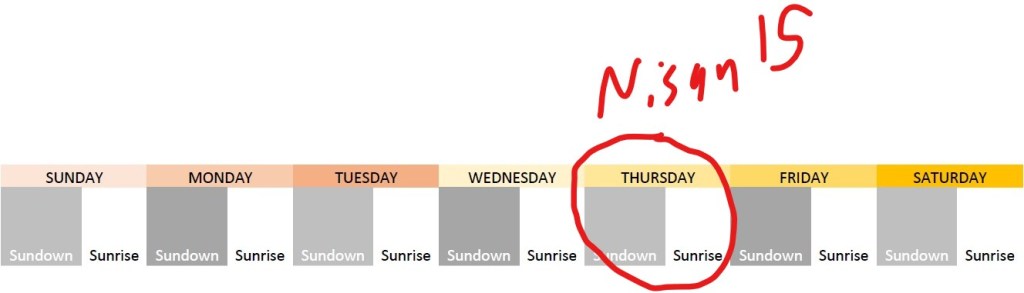
But then, this would make the “preparation day,” or Nisan-14, a Wednesday.
That’s correct. The only way to match up the diverging accounts of the gospels is to observe that the Messiah Jesus died on a Wednesday after eating the Passover on Passover Day with His disciples/friends/family earlier that very night. He had longed to eat that particular Passover with them, even as they had done for about 3 years or so, and He was about to fulfill what was foretold about Himself from long ago. This means that Jesus died on Wednesday during the day, even as darkness prematurely occurred from noon to about 3 pm. There was a great earthquake, a small-scale resurrection where the saints (not just anyone) who were buried nearby suddenly came to life again and were seen by their familiars who knew them to be dead (*but even that after Jesus’s own resurrection*). The veil of the Temple was torn in twain from top to bottom. When the darkness lifted after 3 pm, there was no doubt great confusion, even as the passing hours of daylight continued towards the night…
But do you see it?
Messiah Jesus, Jesus the Christ, had prophesied earlier that He would be buried for 3 days and 3 nights. Because the next day by nightfall was a High Sabbath, the day even when the priests needed to hurry back to the Temple to do their Feast of Unleavened Bread ceremonial rituals, then Jesus had to have been buried on the evening of Jewish Thursday. Now, let us count the days and nights leading to Jewish Sunday when the tomb was discovered to be empty:

Aha! And there we have it, folks! Jesus was in the heart of the earth for 3 days and for 3 nights, just as He predicted! Here is the sign given to that generation that lived with Him! Here is the Christ– the very Messiah of God!
But wait, there is one more thing to address. And that is the Greek phrasing surrounding the day of the discovery. The Bible is explicit that at the dawning of the day, the women went to the tomb to discover it. Dawn, for us, is sunrise. It surely was the same for the Ancient Greeks. Mark 16:2 is explicit that when the sun arose the women went to the tomb. The phrasing explicitly speaks of the motion of the sun “at the rising of the sun” or ἀνατείλαντος τοῦ ἡλίου. Matthew 28:1, however, states “at the dawning of the first weekday” or τῇ ἐπιφωσκούσῃ εἰς μίαν σαββάτων. Luke 24:1 states that they went very early on the first day morning or Τῇ δὲ μιᾷ τῶν σαββάτων ὄρθρου βαθέως. John 20:1 states that Mary Magdalene went to the tomb so early on the first day of the week that it was still dark (again, consulting the chart above, that would count as Sunday in the Jewish reckoning). The language is explicit about the darkness of evening still being present, which the text actually continues on through to verse 19. Mary arrived on the first weekday (Τῇ δὲ μιᾷ τῶν σαββάτων) when it was still dark (πρωῒ σκοτίας ἔτι οὔσης).
The only way to resolve this is to read the days not according to Ancient Greek parlance, but according to Jewish parlance endeavoring to state the days according to the Ancient Greek language. Remember that throughout the Bible the days are reckoned according to evening first. So, even for a Jewish audience, the phrase of “dawning” could be taken to mean simply the shifting of the days, which always occurred at nightfall for the Jewish reckoning. For some reason, perhaps to be sensitive to the Greek culture around them (or for a practical reason given at the end of this paragraph), the writers used language of dawning, albeit with the understanding of the Jewish reckoning of feast days in tow. Ironically, in this regard, the Gospel of John stands out as stunningly Jewish in its description.
Also, it is clear that, just as our modern Western days are reckoned as morning even while it is still dark, that the mornings could just have been reckoned as they were in what was common between Jews and Greeks. I find this to be sufficient as an answer, that the Jewish writers of these gospels used language in common with the cultural gap between pagan Hellenists and the Jewish/Judean people (who by then were pretty Hellenized themselves). It seems that one ancient translator may have understood this, as the Syriac text of Matthew 28:1 (Syriac being one of the earliest languages that the New Testament was translated into) literally reads that “In the evening of the Sabbath (b’ramsha deyn b’Shabta/ܒ݁ܪܰܡܫܳܐ ܕ݁ܶܝܢ ܒ݁ܫܰܒ݁ܬ݂ܳܐ), the dawn of the first day, Mary Magdalene and the other Mary went to see the tomb.” Clearly, a Syriac translator either of Jewish origin or with Jewish understanding had a similar idea as to what the author of Matthew’s gospel was trying to communicate.
Even so, as the day was still dark and in its nascent phase, the sun was in the process of rising. In all likelihood, and practicality, the sun arose even while the women and the disciples were making their discoveries and running about to and fro in order to uncover the matter. Sunday, the first day of the week, thenceforth became the celebrated Day of the Lord: the discovery of the empty tomb and the Risen Savior.
But wasn’t Jesus raised after the third day? Judging from this reckoning, Jesus would have to have arisen sometime during the day on Sabbath…but even in Jewish reckoning, that wouldn’t be Sunday.
Well, the short answer to that is: No. Jesus was not raised after the third day. The Bible is clear that the testimony was and is that Christ arose on the third day. Paul confirmed this. The writer of Luke-Acts also confirms this in both Luke and the Acts of the Apostles. The Gospel of Matthew also attests to this. In this regard, there may be some logic in the “parts of days” being recognized as the whole, but I personally like the imagery that Christ remained in the tomb until the waning moments of the ending of Sabbath/Saturday, as the sun was setting.
And I have some theological reasoning to favor that. Reasoning that we delve into now.
THE THEOLOGICAL IMPLICATIONS OF THIS
The Liturgical Witness
There are theological implications of the Crucifixion Day being on Wednesday, aside from the testimony of the Messiah being true concerning the duration of His burial. For one, what Paul wrote in 1 Corinthians is certainly true that for us our Passover Lamb has been sacrificed, as the entire Christian world celebrates each year and even more recently. Even more, our Eucharist, which is the extension of the table of the God-King Christ to us in His Church, is the reflection of this Passover, which even Ancient Israel was commanded to eat with family alone. We are all in the household of Christ, and as on Passover Day the Messenger of Yahweh freed the nation Ancient Israel from the Land of Bondage and Destruction, so the Messenger of Yahweh has delivered His people from among all nations from Bondage and Destruction of sin and death!
Just as Ancient Israel lived under her covenant and experienced its blessings with her faithfulness to God within it, so we experience God’s blessings in being faithful to His new covenant through Christ Jesus. Just as Ancient Israel had the liturgical support for her worship by the past signs and holidays of the Mosaic Covenant, so we have the daily reminders and feast days to commemorate our salvation by the Joshua who is better than Moses.
The Eighth Day
Even so, there are particularities found within the gospel traditions. The Gospel of John is rich with meaning that would take a lifetime and more to fully unpack, as even the author himself discovered while trying to pen things down. Still, as all accounts state, Jesus died on the preparation day. And the Gospel of John gives us a great clue in what sort of sabbath that day was, telling us that it was a Great Sabbath/High Sabbath day. But note what Jesus spoke about work in that gospel narrative. For one, Jesus alluded to the coming night, which was to be His death. In John 9:1-4 when Jesus encountered a man blind from birth, He remarked that He and His disciples all had to work while it was day, for the night approached when no man could work. And so nighttime comes for us all. We are all given one life to live, la vida es sola una que Dios nos dió. Even so, as long as Jesus was alive, the day was. Well, my friends, Jesus now lives evermore. But not just that, Jesus died before a sabbath. He had completed the work that God set before Him, as even He spoke with confidence before His death in John 17:4-5 in His prayer to God the Father, the so-called High Priestly Prayer. And so, in characteristic fashion, the author was sure to let us know that it was only after Jesus was sure that He had fulfilled all of what was given to Him, all of Scripture, that He surrendered His spirit to the Father.
28 After this, when Jesus knew that everything was now finished that the Scripture might be fulfilled, he said, “I’m thirsty.” 29 A jar full of sour wine was sitting there; so they fixed a sponge full of sour wine on a hyssop branch and held it up to his mouth.
30 When Jesus had received the sour wine, he said, “It is finished.” Then bowing his head, he gave up his spirit.
John 19:28-30
But this language, “finishing His work,” “sabbath,” “Scripture,” this should lead us to a critical passage of the Bible: Genesis 1 to Genesis 2:3 where God created all of creation, and then blessed the Sabbath where He rested from His labors. But wait…where does this passage of Genesis lead us to in relationship to the Gospel of John?
1 In the beginning was the Word, and the Word was with God, and the Word was God. 2 He was with God in the beginning. 3 All things were created through him, and apart from him not one thing was created that has been created.4 In him was life, and that life was the light of men. 5 That light shines in the darkness, and yet the darkness did not overcome it.
John 1:1-5
And what of the discovery on the first day of the week, while it was still dark? This has long been considered in Church tradition to be the Eighth Day, the holiest of days which points to the future where the final and never-ending Sabbath of God is brought to creation and where evildoers and Death are finally vanquished. In Christ’s resurrection of life, and from the light of the empty tomb, even as the night of the first day of the week approached, Jesus broke forth in the glorious splendor that He possessed from eternity as God, vanquishing even night itself.
And so the God-Man brought about the greater sign of the never-ending Eighth Day, which was prefigured in so many signs of Torah– including the very Passover-Unleavened Bread season itself. Having given us the greater sign, He is faithful to bring us the fullness of the substance in His due time.
The Man who Restores the Restful Work
Mary Magdalene could be forgiven for mistaking Jesus as the gardener. Jesus was crucified near a garden and buried in that same location in a new tomb. And we know that it was dark when Mary was at the tomb, even when she went back for two of the disciples (Peter being one explicitly named). However, why would she mistake Jesus to be the gardener instead of one of the Temple soldiers guarding the tomb? Well, I now borrow from Pastor Jeff Durbin in Arizona in saying that Jesus, now and forever fully God and fully human, then was on earth having finished the redemptive work of His Father.
What more was there for the Last Adam to do? Well, there He was in a garden. What was man made for, to what end did He with the Father and Holy Spirit create mankind? Well, to steward the creation of God on earth, to take dominion, and to care for the ordered Garden that God built. And so, even as perhaps Mary, Peter, and John ran past Him on the way to the tomb, Jesus was working in the garden while it was still dark, making it beautiful so that passersby would recognize its beauty once the sun dawned, as gardeners often do.
Work for Jesus was now a cause of glorious worship, and no longer a task fraught with sickness, pain, and death. And that eventuality awaits us in the full, even as we enjoy our work here on earth as God has given us this time while it is still day for each of us.
The Conqueror of the Idolatrous Calendar
I could go on for a long time on the symbols here, but I won’t. There is still something else to get to. But suffice it to say that we are not given weekdays for anything in Holy Week save for one thing in the Gospel of John. The Triumphal Entry is explicitly said to have taken place 5 days before the Passover (which would have been Nisan-15 for the Johannine narrative). Now, factoring that into a week is easy enough. If you consult the chart, you merely need to move your finger back back 5 days from Thursday. This brings one to Saturday/the weekly Sabbath. The day “Saturday” happens to come directly from the pagan reckoning of the day, and relates to Saturn, both the titan and the planet said to be his patron star in the past, which in turn may relate to the Babylonian deity Ninurta. But, that connection is more likely due to Sabbath being the day of rest, and Jesus coming in triumph to bring peace to those who accept Him as their Lord.
But…Jesus died before Thursday that Holy Week. And Thursday was the day of His rest, the day of His victorious enthronement. But what was Thursday named after in Greco-Roman reckoning? Whereas in English the day takes on the Germanic reckoning of being Thor’s day (just as Tuesday is Tyr’s day and Wednesday is Odin’s day), the corresponding deity for the Ancient Greeks and Romans Jesus lived among would have been Jupiter/Jove/Zeus. The day was known specifically as dies Iovis/ἡμέρᾱ Διός by the pagan Roman society sometime around Jesus’s time, but definitely in later centuries. Remember, the pagan Ancient Greeks did not follow Jewish sabbath customs, and this was true even after the Church was established. The word παρασκευή simply meant “preparation” to them and had no sabbatical significance– it did not mean Friday! But, the day we know as “Thursday” was the designated day of the patron deity of the Roman State/Empire, and that same deity also was the patron deity of the previous Hellenistic Empires that ruled over Judea and the much of the Old World. But you know what Jesus did? He conquered that day for Himself, consecrating it as the day that He triumphed even over the pagan deities of Greece and Rome by conquering the day of their chief patron deity Jupiter/Jove/Zeus! Jesus did just as He had done with the gods of Egypt, establishing Himself alone as the God of gods and Lord of lords.
WHERE WE MUST GO FROM HERE
Now we must contend with where we must go from here. Even as I write this on Sabbath, and fittingly so, we must come to realize what we must do in light of this truth. Some may still be hung up on what has all been said, and I sympathize with them. I even humor them a little. I can imagine one of their cries:
“But wait! If you are saying that we know the actual date of the Christ’s death, and even can deduce the very weekday from Scripture, then can we not use astronomical reasoning to get to particular years for this to have happened? Wait, when was the last time that these two calendars lined up like so?”
To answer your last question, I can put it simply. The last time that the Western weekdays lined up akin to what I believe it was in the year when Jesus died was just last year:
2020 AD.
Yes, the very year when Church congregations all over the world shutdown and did not celebrate Easter/Pascha for fear of death was also a year lined up with the conditions when our Lord triumphed over Death for us all. It was all a part of Panic 2020. Nisan-15 fell on a Thursday last year, so in the reckoning of that time, the calendar weeks of both the Jewish reckoning and the Western modern reckoning aligned in a particular manner that re-enacted the texts just as they are written. Had we celebrated faithfully, it would have been possible last year to illumine ourselves to this very truth. Every generation of saints has its struggles, and no doubt, because our enemies are cunning and long-lived, we will face other threats also when this one is past. But the gates of Hades will fall, and Christ’s Divine (War) Council will triumph over the forces of darkness.

That being said, we ought to not wallow in the sadness of this realization. For Christ is risen, and His prodding of rebuke is towards His kindness, which calls us to repentance in faith.
This is why I have written this, so that we all may be encouraged in knowing what He has done, and so that, in ever-decreasing imperfection, we should fathom the weight of glory that is held in this truth of the Scriptures.
A quick thank you note
Though I made this discovery several years ago, back in 2017 to be exact, it is fitting that it is written down now. I also have the same friend from a previous post to thank for prodding me to write this…well…him and his extended family who encouraged me to write this last week on Easter. I thank you all for having me with you this past Easter and Passover. May your hearth continue to be warm. Others have also prodded me, and I thank you all as well.
This is the crux of the matter: We who are truly His disciples, truly Christians, have much work to do. We must work diligently and faithfully, wholly reliant upon God’s ever-sufficient grace, and striving by faith alone, for our Lord while it is still daytime for each of us.
And a great place to begin working is with demolishing the stranglehold that the fears of death and of man have gripped around every man, woman, and child due to this current panic. We must work to bring the light of hope we have come to know and hold onto into the hearts and minds of all who dwell upon this earth. Only the grace of God empowers us to do this, and only the mercy of God qualifies us redeemed sinners (being redeemed sinners in the continual sense while upon this earth) to accomplish this task set before us.
And yes, there is a year when this could have occurred historically to match the believed timeline of Christ’s life as well, for those who wonder. If astronomical projections prove to be sound, then the prospective date in history for the death of Christ is actually sometime in 30 or 31 AD. But do not get hung up on that and miss the consequences of the resurrection! Christ lives now as God-King! What do you do for Him with the daylight that He has given you?
The joy of the LORD is our strength! Let the Redeemed of the LORD say so! Let us work while it is still daylight, for the Eighth Day of the Lord awaits us if we prove by His grace to be faithful to His calling.
18 Jesus came near and said to them, “All authority has been given to me in heaven and on earth. 19 Go, therefore, and make disciples of all nations, baptizing them in the name of the Father and of the Son and of the Holy Spirit, 20 teaching them to observe everything I have commanded you. And remember, I am with you always, to the end of the age.”
-Matthew 28:18-20
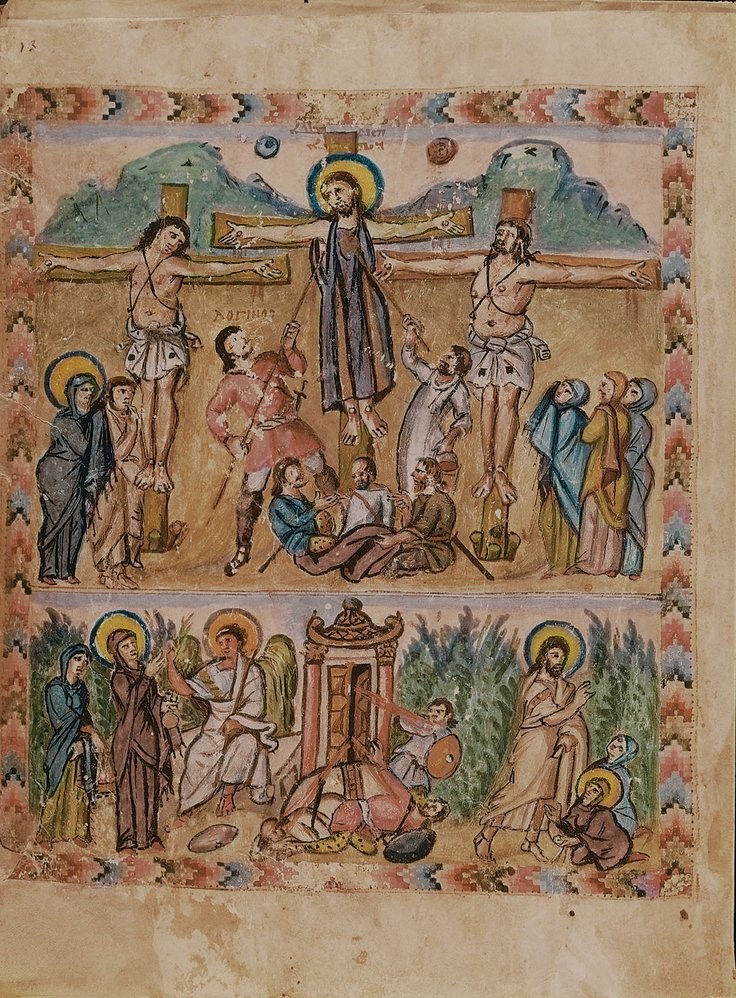
[The image displayed on the preview of this post in the main page of the blog is from a 6th-century Syriac illuminated manuscript from the Rabbula Gospels. It is currently found in the Laurentian Library in Florence, Italy. It has both a Syriac inscription (above Christ’s head) and Greek (above the soldier stabbing Jesus with the spear). You can read more about it here.]
*Edited on April 15, 2021*
 The Reasoner's Corner
One thought on “That the Christ Died on a Wednesday”