

By Kerwin Holmes, Jr.
9 My children—I seem to be in labor with you all over again, until the Messiah is fully formed in you!
-Galatians 4:19 (New Testament for Everyone Translation)
It has been some time since we have gathered here at the Reasoner’s Corner. Recent events have made it such that there are many things which are prudent to say, and hence, very prudent to be heard. There is great alarm in the world today, and much of that stems from the failed assassination attempt of former president and current presidential candidate Donald J. Trump. As one 20th century author and theologian once put it “we have cause to be uneasy.”
What I write here now traffics in more than mere reflection. There is a good deal of previous prudence yielding to exasperated, but not too uncommon, predictions that needs to be revisited. However, if you believe that this will be another confused or hair-on-fire take from yet another voice on the internet, well, I suppose that you may make your evaluations by the end of this post.
But for all intents and purposes, there will be toes stepped on in this post. Once again I raise the wish that I delivered previously years ago: I hope that we are all wearing sandals.
I also write this in light of also having held another unfinished draft (the most recent unfinished draft…I have several) that concerns the recent goings on in Israel, for several months now. As it stands, I have not visited that draft since about November 3, 2023, when I became just a bit too exhausted with the floodgates of propaganda and the ridiculousness of the conversation (including the ridiculously persistent Eurocentric labeling of modern-day Semites living in the Middle East as “anti-Semitic” instead of just “anti-Jewish,” if such a label appropriately applies). Even I could not avoid all of the shades of stupid that flowed out from the massive groupthink that was going around at that time, and since even more information is still coming out concerning what happened on October 7, 2023 in Israel which started the present Succoth War (and I call it that apt name for reasons to be explained in that post),1 I hold it as justified on multiple fronts that I purposefully drag my feet on that.
I freely admit that during that time I was preoccupied with doing more offline than online. That blogpost will be posted eventually, just not right now. As it happens, though I am a Jew, I am a U.S. American and I live in the U.S.A.– not Israel.
That is all that needs be said about that.
The Church
I start by properly first addressing the Church. Let it be known that I have written very recent posts in the past that deal with the cultural failures of the Church– failures which lay squarely upon the pastorate and the people who support their lackadaisical leadership…especially the people who ask and demand for such lackadaisical leadership based upon misconceived, supposedly “Biblical” foundations. I have much to say here, but I cannot say it without illustrations, both generic (as in those available to the public eye) and private (those coming from my own personal experiences).
In that vein, I will be principled in speaking the names publicly of ministers who have demonstrated a dropping of the pastoral cloth for something more seamless to be worn around the waist and covering the knees (typically worn by women), and not naming, but very much describing those who have done so in private who do not have such a large platform. I do this from the position of mercy, since I have no qualms of calling out pastors even when said pastor is (functionally) “my own” pastor (e.g. the very first blog post that I have ever posted). But even so, I realize that there is prudence for naming someone with a larger platform and who publicly erred, so as to give you readers a tangible example. I endeavor to walk that balance.
My record demonstrates that my mercy is motivated from actual mercy, and not by cowardice. If any pastor in my personal life wishes to contact me for a conversation after having their toes stepped on, you know how to do so. If not, then (as my British neighbors say when they are feeling most polite) kindly carry on.2
As a Christian layman, and a son of a pastor/preacher, I also appreciate the weight and pressure of the pastoral office. It is partly why I do not desire said office (apart from the fact that I am not called to it by God, but I am a teacher), and it is partly why, while remaining a convicted credobaptist, I have for more than a decade spurned the independent congregational and anti-episcopal model that eliminates inter-pastoral oversight and accountability, which is commonly found in the typical Baptistic denominational structures.3
Be that as it may, as I said in the colorful language above, many pastors have shed their pastoral cloth for something more wavy and useful when the summer days hit…spiritual clothing that tends to come out during Eastertide when the women enjoy the heat and winds of the summer breezes to wear something cool and brightly colored, forthwith showing us what season of the year we are in.
I, of course, speak of summer dresses.
But robes are not dresses, even if the robes are pastoral.
Perhaps we need more subtle reminders.
First, I have to define a term that will be the source of contention in this section. That term is “politics.” Many are confused by this term. And in today’s climate of suddenly polarized binaries and unspoken moral truces leading to backbiting allowances, it is clear as to why that is so. The political world is topsy-turvy, and far too many cope by living in a world of spin. Nevertheless, I will endeavor to offer my own working definition of the term “politics” so that you, humble reader, will have an operating understanding of where I am coming from.
Politics — the method, or institution of policy, which governs how people interact with one another.
It may seem broad. But when you consider the things we label as “politics,” you will soon realize just how operationally motivated this definition is. Some people mistake “partisanship” or being “partisan,” that is, the allegiance of someone’s ideas to a particular political party platform or institution, as “politics” or being “political.” No, this is not the case. Anything can become a political issue without being tied to a political entity such as a political party. And in today’s world where we increasingly have little common cultural ground, which then makes everything not on that shared ground up for debate and questioning, we will find that nearly everything will be “political.” That is, everything will be open to negotiation and critique as to whether it is valid for human interaction. The further we drift apart going our merry ways, then naturally the more political everything becomes.
By the way:
Political — anything that participates in the negotiation of politics.
Now, you may say that something such as, say, abortion, is not interactive in the same way as whether my neighbor can drive her car through your home’s front door. Well, once again, we have to clarify that abortion does not escape being a rather political issue. Whether or not a mother decides to murder her baby impacts that infant’s life. It also impacts the life of the father. And it impacts the rest of us as we will then lose a contributing taxpayer, at the most inhumane end of the spectrum as a society, or we lose a potential friend, confidant, or spouse in that decision. Furthermore, the encouragement of abortion policies has impact on how you, should you choose to have a child (whether as a mother or a father dependent upon your sex), are able to go about doing so. If abortion is allowed and it favors the mother’s decisions,4 then a man’s civil interactions with the mother of his child are constricted by the mother’s civil will, making the mother more legitimately the “parent” to said child than the father, as she has more rights in determining the child’s ultimate fate– even rights that God does not grant her, such as the decision of the baby’s mortal life without the child’s grand jury conviction of a capital crime. For those who are slower at seeing what just happened, please take note of the aforementioned relationships which preceded which also necessarily constitute civil interactions between persons: “mother of,” “father,” “parent to,” and “child.”
I have to spend a considerable amount of time explaining all of this in this section dealing with the Church rather than diving right into my critique principally because of the core substance of my critique: Pastors do not explain this civic wisdom AT ALL to their congregants. In fact, this is largely because pastors themselves do not know this civic wisdom, which is because pastors are largely unmotivated and thereby incapable of attaining said wisdom. Civic theology is apparently not taught in seminary.
Now, I get into the meat by way of demonstration.
Not the Bee is a non-satirical news source and offshoot of The Babylon Bee, which is a satirical Christian website. In the website of Not the Bee (NTB) there is a section called “Takes” where different writers offer up their “takes” on society in blog entries. These takes are not officially endorsed by the editors at Not the Bee (NTB). But they do give an instantaneous insight into the minds of select Christian contributors who themselves are representatives of the thoughts and minds of U.S. American Christians, particularly from a more conservative-leaning base. On their website at this moment are two posts, the images of both I will provide here with their titles. Click the images to read the posts.
One is entitled: “Of course the Republican Party has moved on from Evangelicals. Here’s why you shouldn’t be surprised.”

Another is entitled: “Ministers, don’t let political chaos distract you. Preach the Word.”
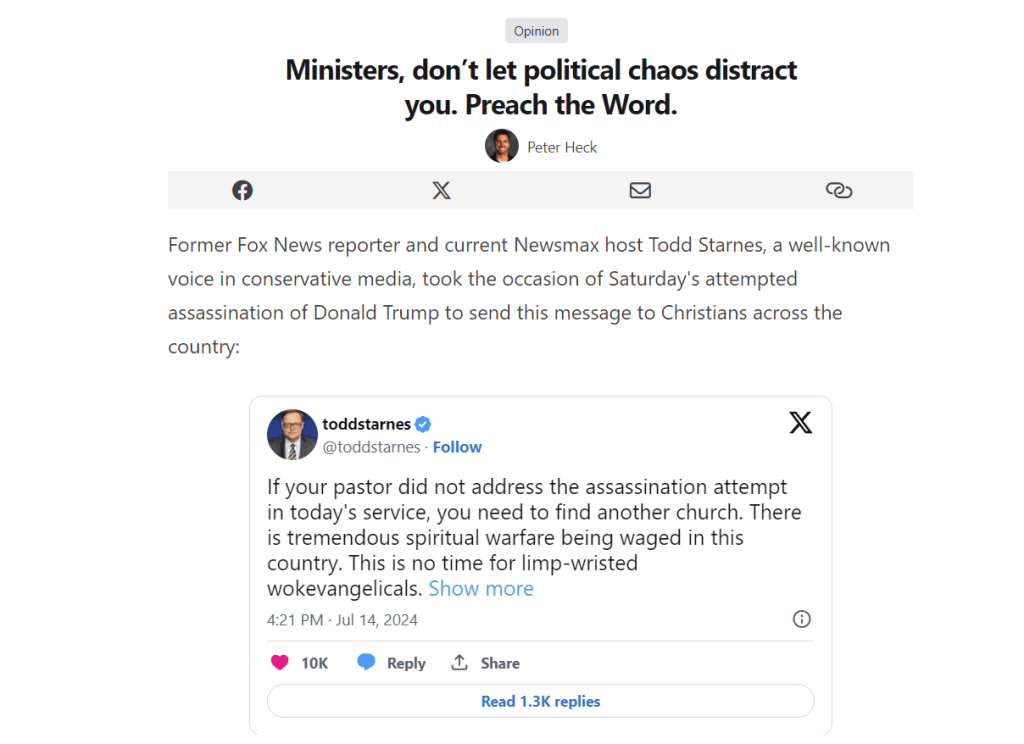
Now, it does not take a rocket scientist to determine that these are two at odds and conflicting notions for a Christian to take in coming from the same publication. And I do not critique the editors of NTB for doing this. I, in fact, applaud them today for allowing me a way to illustrate my critique of the Church by way of example. I encourage you to read both articles as they are shorter than my present post.
Here we have two different takes, one which takes aim at the Christian ghetto that we have built around ourselves that is void of cultural relevance or cultural stability within to deal with all of the complexities of human life. The other is a call for the resistance of any intrusion into the public sphere of political activity and/or activism, the working distinction being that the first is any mere acknowledgement of a political reality and the latter is any advocacy in light of said political reality.5
Like it or not, a young man decided to attempt to murder a former president last week. And since the ear is a part of the head, it is wholly appropriate in saying that he at least succeeded in hitting former president Donald Trump “in the head” if only by grazing his ear. And also, tragically, the murderer succeeded in wounding at least one other rally attendee and murdering one Corey Comperatore, a husband, father, and retired firefighter who, by initial accounts, also happens to be a fellow Christian.6
That is the political reality.
Like the wisdom of so many others, such as Shakespeare or Aesop, let me use a situation beyond our current one to demonstrate a bit of prudential7 wisdom. Say that you live in the state of Mississippi in 1832. Say that you attend a Methodist congregation which is dealing with the still recent fallout from the publishing of David Walker‘s Appeal.8 Now, assuming that you are in Mississippi at this very time attending, rather openly, a Methodist congregation, in this alternative timeline you are a “white” American person. By default, living in the Antebellum Deep South, there are plenty of people, be they rich planters or poor yeoman farmers, who are rather consternated by the content, whether they heard or read it, of the pamphlet. You know of the gathering of some “blacks” down the road in a shack to play games or have some leisure during their Sunday off.
But at this point you yourself are leery of enslaved black persons gathering for religious ceremony, Christian or not, given the conjuring up of the Stono Rebellion and especially the very recent uprising led by Nat Turner just a year back, a name that makes mothers around you instinctively clutch at their children in knowledge of what Nat Turner personally did during his rebellion, let alone what others did inspired by his preaching. But let’s assume that you have all of the knowledge of today of what will happen in your nation further down the road: how your descendants will view you, how you will come to view yourself, and how your action or inaction at the present moment will define your Christian legacy and the ministries of others down the line.
Should your pastor say anything, if at all, about African chattel slavery that Sunday? Should he say anything any Sunday? Are you okay with the state legislature of Mississippi recently restricting the (even religious) gathering of all blacks, free and enslaved, without passes authorized by white officials, and the forbidding of their learning to read in direct response to Nat Turner?
But it’s all just politics, yes? What does God have to say about how people interact in this matter? What does God even have to say about how we govern how people are to interact with one another, as if He cares in the slightest?
Even still, wouldn’t your pastor, to be in the right, have to come down on one side or the other, either to condone the murderous actions of Nat Turner and those around him, or to side with the overbearing governments of the states in the Union, which allowed the retaliatory lynchings of scores of black folks up and down the Atlantic coast and the setting up of draconian laws even against free and lawful citizens based upon ancestry?
But such is a false choice. You may not have even noticed that I framed it from the human pressures of your position, as a person who knows how humans will write about you. But what of God? Perhaps in our reasoning so far, we do not consider His standard, and thus, we even fall victim of seeing His “side” as an actual parcel of moral ought and option analogous to the two human ones. That “side,” this “side,” or God’s “side.” Maybe we shouldn’t lower God’s autonomy to the level of man.
And in that Antebellum case, your pastor ought to preach.
But what about now?
What say you, gander? Is it also good for the goose?
But, some will say, Jesus never truly became “political.” Thus many pastors preach. For generations we have heard the same.9
But let us see: in 1st-century Judea, the Jews of the days of Jesus faced many political concerns. The primary one, which later came to define a rather tumultuous grasping of power and total renovation of their society in the decades and centuries after judgement came to Jerusalem on the Messiah’s behalf, was the settling of the many factions of Jews and just how faithful or “Jewish” a Jew had to be to authenticate his or her Jewishness. Principal among the debaters there were the various schools of political factions known as the Pharisees, the Temple politicians of the Sadducees, and the Hellenist-Roman partisans of the Herodians…and Jesus never debated those people.
I mean, they had lawyers and scribes and lawmakers and teachers on each side, and Jesus never debated nor purposefully insulted and mocked lawyers in His minstry.10 And He certainly never went against the actual Hellenistic city government of Jerusalem– the council which governed over all of Judea according to the precedent of the Greek Empire which ruled over Judea for over 100 years– the council whose seat of power was the Temple in Jerusalem where Jesus never dared to enter, lest He challenge their own institutional authority right there in the courts of justice. After all, the city government therein was an old and respected system gifted to the Jews by Alexander the Great and continued through the Hasmoneans and adopted by Rome: the Synedrion aka Senate aka Sanhedrin.11
Come closer, and I will tell you an insight that nearly every pastor knows, and which most PK’s12 know as well, along with every aspiring seminary grad: the most common source for pastoral sermons…are other pastoral sermons. Yes, even within the traditions of Sola Scriptura, there are great and even greater leanings upon the sermons of esteemed and collectively acknowledged pastors than there is in basing sermons upon the texts and contexts of historical times. This is especially true the more one relies upon liturgical proceedings during the sermonic services of Sunday rather than personal exegesis. The practice is not inherently evil. But say that there is a shortsightedness coming from one pastor who is highly esteemed? What stops his biases, perhaps stemming from his personal lack of study, but also possibly from his own discomforts and temptations to “live and let live,” from creeping into the sermons of all those others who copy him? And what stops yet further copies as others who relied upon him become emulated by later generations?
Such is the inherent weakness of any tradition. And it is surely this way with the pastorate across Christendom.
Here we have our first public example of such waffling that not only leads to confusion, but also, surprisingly, a bit of a chest beating over something that actually is objectively wrong. For it was not John the baptizer who called Herod “a fox…”13
What happens when Christian pastors stop listening to Christian historians…or historians and academics at all for that matter?
Goofy stuff like this may occur. But you may be surprised to find that the speaker is actually Dr. Ligon Duncan. His is the practice of prying the Scriptures over and studying, wrestling with them and dealing with the texts with a certain care and mission as that of a bus driver studying the routes of his sector, or a general studying the topography of a battlefield.
But how did Dr. Duncan, and so many others, simply miss the overtly political situation of Jesus’s words and deeds– such a political fact which precipitated Christ’s own crucifixion by His own government hand in hand with the Roman imperial approval?
The answer is simple: he did not find it because he did not go looking for it. In his own chamber of pastoral understanding, with walls which echo pithy and noble sayings from the procured wisdom of God through the sages, such a sermonic sound was not heard. And since, as all seminarians learn, the sound was not heard in those hallowed halls of the pastoral chamber, it was not sought out.
Innovation, my friends, is deadly business, for God revealed all doctrinal truth at [X marks where your denomination’s birth began], and so anything new and not said by those before, even if it truly be wisdom more ancient than what we have lost to culture and to time, must be suspected.
Just ask the Ancient Jerusalem Senate.
For a personal anecdote, I once attended a congregation where a pastor, in the spirit of “not being concerned with civilian affairs”14 went on a small lecture at the beginning of his sermon on the evils of abortion and how our current political castes idolize it for their own partisan gain. But, in a very confusing turn of phrase, he said that he was not preaching “politically” and that he does not preach “political” sermons. I merely thought, my pro-abortion colleagues and neighbors would have begged to differ.
Again, at the same congregation, the pastor rebuffed the forlorn and tempting romanticization of the 1950s, which the Political-Right has become enamored with recently. He did so by calling out the ways in which those days (truthfully) led to the calamities of our own through things such as “easy believism,” a truncated gospel message, and the lack of authentic Church piety. I must admit, sitting there amongst a mostly white congregation and knowing that at least one of my Korean friends was dating a white woman, and also knowing that the Political-Left has used as a cudgel from the history of the Church in the United States the Church’s endorsement of segregation,15 I could tack on yet one more glaring issue from the 1950s that has led to our current malaise and a reason that we shouldn’t romanticize the past. Suffice it to say: when one cuts off things considered as political from the gospel message, we lose the critical application of the gospel message to our society. We become quite goofy and irrelevant, and understandably so.
It should be of no surprise that in the pastoral realm where sermons source other sermons, there is a bit of creep where the timidity and awkward silence of past generations rear their heads up in the new.
Funny how that works.16
Now, currently there seems to be a bit of an acknowledgement of how goofy the apolitical take on Christ’s life and His Church actually is among some in Christendom. I speak with a bit of colorful imagery that also, I submit, humbly does reflect some of the reality here:
the nerds are fighting.
Pastoral nerds on one side are pushing against pastoral nerds on another. And if you have ever seen nerds fight, it’s awkward, unrefined, and largely unfun. Nerds need to learn how to fight. And that’s what is happening right now among some of the pastorate, as even reflected in the conversation that Dr. Ligon is having with Sean.
In addition to that, some among the conservative Church, especially the Evangelicals, and perhaps most jarringly among the Reformed Evangelicals, are rediscovering the bygone but still all too current truth that the world is actually quite fantastical. They are discovering, to their religious delights, that the worlds of C.S. Lewis and J.R.R. Tolkien were not simply aspirations, but rather were based largely upon how fantastical our world actually is. They have gone round the bend of modern man along the pathways of progress of the Enlightenment, and around the tree of knowledge, to end up at the discovery that the Medieval Church got a lot of things right. Glory and Hallelujah! But, as I have mentioned and warned before, they have discovered something that comes with great responsibility to wield, and they are largely untrained– uninitiated, even. Let me be clear: there should never, ever come a time in Christian dialogues and in Christian diagnoses of our days when a Christian calls another imago Dei human being a “demon.”17 That is just false. And even where there is demonic activity, it is not always the case that the demon is the one driving the program. Learn the lesson of Pharaoh who continued on even after his own gods were defeated, and never sidestep the responsibility and tragic depth of human wickedness in and of itself. Evil people unite in their common goals for evil (the Pharaoh and the gods of Egypt who empowered his magicians) just as good people do (Daniel and Gabriel and Michael coming together to bring the rest of us an assurance of the times).18
Yes, be vigilant. But be careful to mature into that vigilance.
Finally in my critique of the Church, let us do one more thought experiment. Humor me, dear Christian. You know that Christ came into the world and did wonders, and you now know that He overtly was political on His terms.
What if the Christ never came? What if He just decided to not show up? What if God the Word looked down upon humanity and said “No, I think I’ll pass?”
Why, it would be a dereliction of duty, yes? It would be a divine scandal. God would be proven a liar and a charlatan who merely pontificated on goodness but never showed it, and despite His past actions, we would be right to say that He never truly exercised it.
Tell me, then, teachers and learners of the Law: Why does Paul call us the Church Christ’s Body? Again, what if Christ were upon the earth today? What would we expect Him to be doing as a human being in our world? But what are we? Why, are we not Christ’s Body, the Church? Step aside the ways that we often only have wrapped around conflating this to the elements of the Eucharist. In the very same way the bread and wine are called, so are we.19
So where is Christ? Is He absent your city halls, absent your governments, absent your schools, and absent your television shows and songs?20 And whose fault and dereliction of duty is that, fair Christian, fellow member of the mystical Body of Christ and partaker of all His mysteries?
If I may quote, with censored caveat, a popular Armenian-American rock band in their song “B.Y.O.B.”–
“Where are YOU?”21
So then, with regard to the two NTB articles: Yes, the one saying that the Republican Party, with its sappy and wussy religious doting, has no concern for the politically weak and morally uninspiring Church (evangelicals merely being the loudest factional voice within the Church in the U.S.A.) while headlining a pornstar and appealing to another religion that has no dealings with the founding principles of our nation, is correct. And the second article is confusing.22 Oh, you thought this would be a “well-balanced” give and take? Life rarely works that way, and it does not work that way here.
But, for the second article, the solution is the same: preach the gospel. Just, please for the love of God and all that is holy, people, laity and pastors, and I say this with full truth but also with an ironic emphasis, whenever you do preach the gospel:
“Know what the devil you are preaching about!”
The University
You will be happy to know that these next sections are dramatically shorter than the preceding one. It is just that Church-folks take a little while longer to talk to, particularly when you mess with their programming. It takes one to know.
But this current section is one where you may say that I have potential to incur some particular ire, though I also know that I am writing in the spirit of academic challenge and concern. So here goes.
It has now been about 5 days at the time of my writing this sentence since the attempted assassination of a former president and current presidential candidate. Such an event is both a sign of the rupture of our ability to hold frank and necessary discussions, and also a national calamity that affects each and every person in this country, whether they see it as a calamity or not (more on that later).
So then, I am right now a curious man. Note that my name has been posted on each and every blog post. You may find some academic information about me online. But I am curious how at the university I currently attend I received an email from the official offices that lead the university concerning the conflict in Ukraine (a foreign nation) which offered support and understanding to those affected. When the tragedies that sparked the beginning of the Succoth War took place last October in Israel (a foreign nation), likewise, an official email was sent to all persons connected with the university offering support and calling for understanding.
But, by direct contrast, in a university which by default has way more U.S. American citizens involved in her, and at a university so well-known to send alumni to Capitol Hill that it was mentioned in season 2 of Reacher (a popular television show) for the fictional Capitol Hill character Daniel Boyd, not a single official emailed statement from the higher ups has been sent out offering support for anyone jarred by the events nor, most importantly, an open encouragement and endorsement for understanding and civility.
It has been 5 days. But I have received other emails per the usual: the alumni fundraisers, the arts, the good things that our faculty and students continue to do in the world.
And I do hate virtue signaling. But no calls for civility from the top brass at a U.S. American university, whose founder was no less than the third president of the United States, after the attempted assassination of a former president?
Seems odd, no? Perhaps now you are curious, too.
I mean, even if one were to consider oneself on the higher ground politically-speaking, taking a page from the ethic shown by God from the Torah to Christ the Author and Interpreter of the Torah, wouldn’t you want to show clemency and charity to your enemies even so as to shame them into how they should act?23
And I have a strong suspicion that my own university is not the only one that has largely ignored this event. It is just a bit jarring. After all, I daily pass by effigies and statues and an entire monument (the university itself) built upon the very legacy of a U.S. American president.
The Society
This is the penultimate, brief section of this blogpost, and it will be the most no-nonsense. It is very clear from the multitude of reactions to the attempted assassination of Donald J. Trump that there are many people in our nation, our countrymen, who have no clue what political moderation is. Hopefully now that you are using the operational definition of the word “political,” you fully understand what I am saying.
Numerous videos have been made to shed light into this, but I will post the more useful one here.
Now, you may remember from back in January 2016 under then President Obama when I wrote at the close of my observational warning: “This deep and widening political and partisan divide that has us all tearing at each other’s throats; this is the state of the Union.” You may even remember when I documented many of the politically corrupt and divisive things that the Obama Administration performed while only supporting and pushing a partisan unity within our nation while at the helm of Executive Power. You may even be still fresh off of the dishonest scales that I called out not too long ago when our former Attorney General Loretta Lynch called for partisan blood in the streets.
Why do I particularly pivot to the Obama Administration now? Well, because we could not have had a Trump Administration without his. And likewise, we cannot have an attempted assassination on a former president without the current Biden-Harris Administration’s vitriol against the president.
Society yields what you sow into it. And the problem with all of this is that we are now in a situation when the mantra of the partisans who rule our conversations is one of wanton self-actualization. Yes, the Radical Left is quite obviously the more institutional threat at the present moment because they dominate the government, the arts, and the intellectual spaces. But pay attention to that NTB article about the Partisan Right embodied in the Republican Party. There is not much any moral difference there in mantra, but only in degrees of actualization, which one would expect from an institutionally weaker opponent.
It is even present in the stories that we tell ourselves. A culture cannot help but to infuse moral oughts into its narratives. So then, what does it mean when a corporate takeover of a space myth rooted in religiosity and the moralizing of human history cedes creative action and upends its own in-universe canon in order to pontificate the Luciferian notion that self-actualization, even self-actualization into something called the DARK side, is the essence of what is just and good?
Credit: Jesse Grant [Language Warning], Original URL: https://www.youtube.com/watch?v=SD8bflWn4FY
Keep in mind: this is from a children’s entertainment company. This is the cultural morality discipling our children.
But what else is there, when morality is based in me? You see, without an outside and external basis, people like Destiny cannot see where “the extreme” is. In order to be extreme, you need a definite point of relationship outside of yourself along a trajectory that defines you, and not you defining it. And oh boy, has our culture (and especially Disney) rejected that moral cosmology a long time ago.
Without God, we are lost of the moorings of what good and evil is. We, in our nation, have careened past Genesis 3. Do you know what chapter comes next in that Tragedy?24 Genesis 4. Seems that we are right on time, no?
The Parting Point
And so, I end the blog post. But I will end it in this fashion: with this summation by observation.
So, you Christians deserted the civil circles of society, ignored the arts and the power of “the story,”25 the Socratic intellectual spaces that we esteem hate Socratic deliberations or Jesus-level social critiques, and our society feeds itself on the destruction of our neighbors.
We train for battle against each other in the very halls of peace. We destroy the center and yet claim that we can hold everything together by destroying any semblance of unity beyond ourselves. What ever the Hell is unity if it cannot be beyond ourselves?26
We entertain ourselves by controversy, we learn only through anxiety, and we create only for purposes to destroy.
But we cannot turn away. The arena is just too captivating. And we must see who wins, after all, who wins, that is the call to us. Who wins? Let’s fight and tear and rip and plunder. We raise our hands to the very heights of heaven for violence, and bend our ears down low to hear the most chthonic praise.
Well, what did you expect. Look around you, man. Don’t you see it, my dear? It is all around you. The arena ROARS, and the likes and follows abound…and are you not entertained?
Isn’t that what you put into the system? Isn’t that why we are all here?
And here we all are.
- I’ll give you a hint, pay a modicum of attention around the sides of the conflict, look up the meaning of the Jewish festival of Succoth, and then look at the timing of Hamas’s attack. ↩︎
- Or, if you like, “bugger off,” dependent entirely upon how catty your reaction turns out to be. ↩︎
- Indeed, one cannot get past reading the ancient Roman letter of 1 Clement without encountering a jarring example dating just after or even within the lifetimes of the apostles that demonstrates the foolishness of such a minimized and yet somehow pontifical model. And this is without pointing out that with organizations such as the Southern Baptist Convention and others, Baptists themselves have a hard time following their independent-congregationalist boundaries when the instinct of communal leadership arises from within their pastoral ranks. ↩︎
- This is the overwhelmingly present trend in Western societies. I should note that currently the United States of America has one of the most Faustian pro-abortion laws in all of Western society bar none. ↩︎
- I am aware that the author has the caveat of allowing one’s own personal spiritual guidance by the Spirit as to whether to mention societal ills or not while preaching the need for the gospel in society. But, you will soon see why I find it confusing and instead have just opted to take on the negative aspect of the author’s statement (which is also decidedly the aspect which he chose to put into the title of his take.) ↩︎
- We Christians have the power of speaking of those among us, living and dead, in the present tense. One does not cease being a Christian upon death, unlike with all other faiths– nor do they cease being alive in a certain sense (see John 5:24 and John 11:25). ↩︎
- There is great reason for why I mention this word in its many forms over and again in this post. Catch the truth. ↩︎
- The full title is Walker’s Appeal, in Four Articles; Together with a Preamble, to the Coloured Citizens of the World, but in Particular, and Very Expressly, to Those of the United States of America, Written in Boston, State of Massachusetts, September 28, 1829. ↩︎
- And we have already rebuked those who reduce God to a partisan figurine. ↩︎
- In case anyone wants to be contentious about what the word νομικός meant, which is original to the ancient text, the hyperlink is to the lexical definition. ↩︎
- Again, for those contentious ones: συνέδριον. Many may find it silly now, but Sanhedrin is just an Aramaic corruption of pronouncing the Greek word. You may as well read “(Judean) Senate” each time that you see “Sanhedrin” in your Bibles. You would not be wrong to do so. ↩︎
- PK = preacher’s/pastor’s kid, not to be confused with their eccentric cousin the MK, or missionary’s kid. It’s a vibe. PK can also mean “president’s kid,” but I’m only mentioning one Biden in this blogpost. ↩︎
- Interestingly, this whole episode is written after the episode Jesus had with the politicians. Seems to have been a trend in the life of the God-Man which, amazingly, generations of pastors have missed for a long, long time. ↩︎
- The actual context whence this verse comes makes the application that this pastor used utterly nonsensical. If soldiers were not concerned at all with “civilian” affairs in the simplicity of meaning, then for whom would they fight? And ancient soldiers in Roman domains also served as the police force. The clear context for any soldier is to please the higher military power over him. So what if the general tells the soldier to guard that city wall? Should such religious platitudes of pastoral ought be so easily refuted? ↩︎
- By the way, had we just looked at that same gathering of people in the 1950s in the same town and place on any Sunday at a Church worship service, none of us nonwhites would have been there amongst the rest. ↩︎
- Academics are not much better, by the way. ↩︎
- Want to know what the word “demon” meant in the Ancient Greek language of the authors of the Bible (and times prior)? Peep it here: δαίμων. ↩︎
- See also 1 Corinthians 2. ↩︎
- In fact, in the earliest Eucharistic prayer that we have on record, contained in The Didache, the broken bread (body) of the Eucharist is tied not to the body of Christ personally, but it is tied to the Body of Christ which is the Church herself. ↩︎
- You can read an 8-year old short manifesto on how and why Christians should be the elites of the creative arts here. ↩︎
- System of a Down is the band, by the way. Now would be a good time to scroll up to the top and reread the verse there. That is why it is inserted. And Biblicist stalwarts needn’t worry, it works in application here even from how it was used in the original context. ↩︎
- What if the pastor preaches the verse about Jesus calling Herod a “fox?” Is it…not the gospel, suddenly? ↩︎
- In case pious Christians think such a thing is not a godly motivation: please read Proverbs 25:21-22 and Romans 12:19-21. I mean, hey, in the source text there is even a divine reward involved. It seems that even God has favorites. ↩︎
- In case you have not noticed from reading the Genesis, that entire book, apart from being the first book of the Torah, is a clear example of an ancient Semitic tragedy. It is a tragic narrative to the core which begins with paradisical flourishing and ends with the hopeful hero (Joseph) dying outside of his homeland before even his older brothers and bereft of his people receiving their inheritance to change the world. ↩︎
- Which, if you think about how little Christians appreciate the art of storytelling and the art of seeing stories and themes in reality, it is very antithetical to Christianity. Our own God has decided to speak to us exclusively by means of story and has even chosen to weave His universe in a tapestry of a Master Story composed of many myriads of stories. Most of Jesus’s most famous teachings are simply stories that He told. Why do we cede the arts, which are essentially the stories our culture tells itself, to the illiterate and uncreative? We who worship the Creator ought to have more zeal for creation (and by that, I mean the actual action and artform, not just the creative order). Here, peep this video for an example of religious art with intentionality done marvellously and rightly. Peep here for an example of non-religious art done well (and heck, for that movie, here is yet another one, it is so well done).
Edit August 18, 2024: And you know what, this creator isn’t even a Christian, and even he can tell the purpose and power of the stories we tell ourselves. Furthermore, such is the power of the story and the power of effort in creating beauty that interspersed among the top-notch movie clips is actually a brief scene from a YouTube video…from The Bible Project. Funny that. Source here. Contrary to his own disbelief, stories are even more powerful when they are true, and real beauty is true. Consider this point about “story” well, my fellow Christians. ↩︎ - Paradigmatically, and dramatically, within Christianity unity is found in God in Christ. There is great cause for why even when we unite with one another through our fellow man, as is our natural function, that that Man also needed to be beyond man– the very God in whose image we are all wonderfully made. ↩︎
 The Reasoner's Corner
One thought on “Are You Not Entertained?”